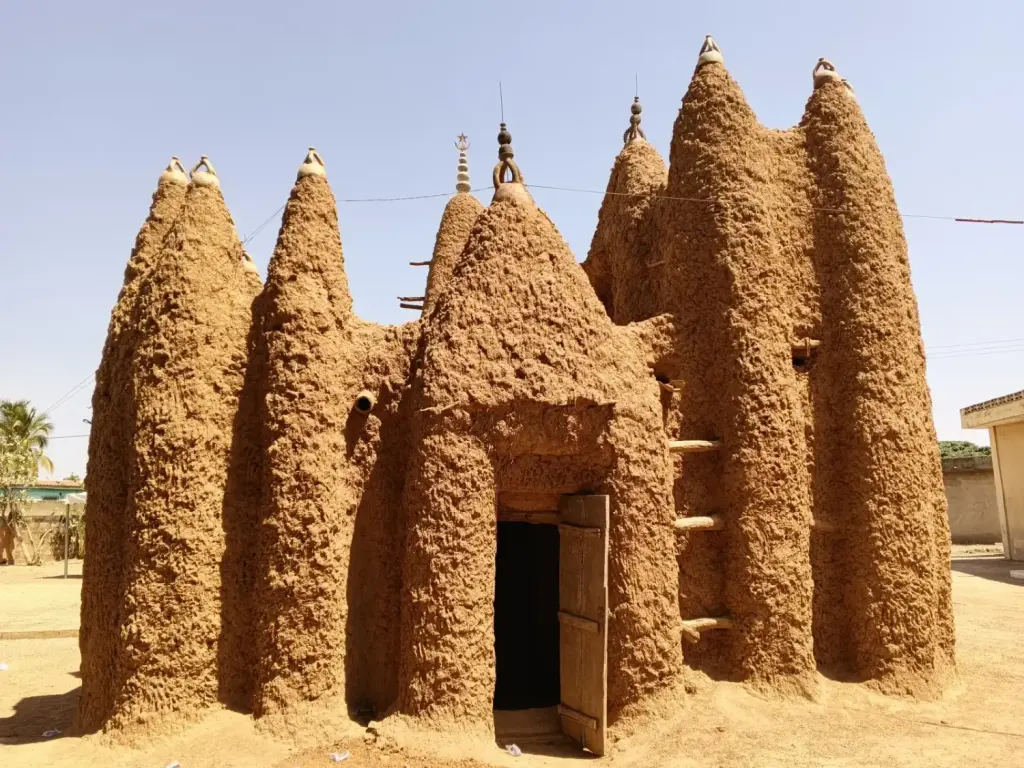
A training site dedicated to the restoration of a Sudanese-style earthen mosque opens this Monday, October 12, in Bouna, in the northeast of Côte d’Ivoire, with more than forty participants and traditional masons engaged until October 31.
The practical phase must combine scientific conservation methods with local earth construction expertise. Participants will work on the building while undergoing technical training focused on built heritage and its adaptation to the effects of climate change.

The project extends a seminar held in Abidjan focused on the heritage in earth construction and climate resilience in West Africa. The initiative is implemented by the International Centre for Earth Construction in collaboration with the African Heritage School and the Ivorian heritage services.
The program runs from 2025 to 2028 with funding from the International Alliance for Heritage Protection. The organization has a budget of $1,543,540 for activities conducted in Côte d’Ivoire, Ghana, and Senegal.
Three groups serve as experimental sites. The Ivorian component concerns the Sudanese-style mosque in Bouna, while the other work focuses on an impluvium house in the Bandial kingdom in Senegal and on traditional Asante buildings in Ghana.
Earthen constructions are particularly vulnerable to heavy rains, erosion, droughts, and other climate changes. These pressures weaken the buildings as well as the transmission of the techniques necessary for their regular maintenance.
The project combines research, professional training, site conservation, and regional meetings. The Bouna site is thus expected to deliver a concrete intervention on the structure while strengthening the skills of those who will be responsible for preserving other earthen architectures in the region.
The training is scheduled to conclude on October 31, after nearly three weeks of work with the artisans and specialists gathered on site.