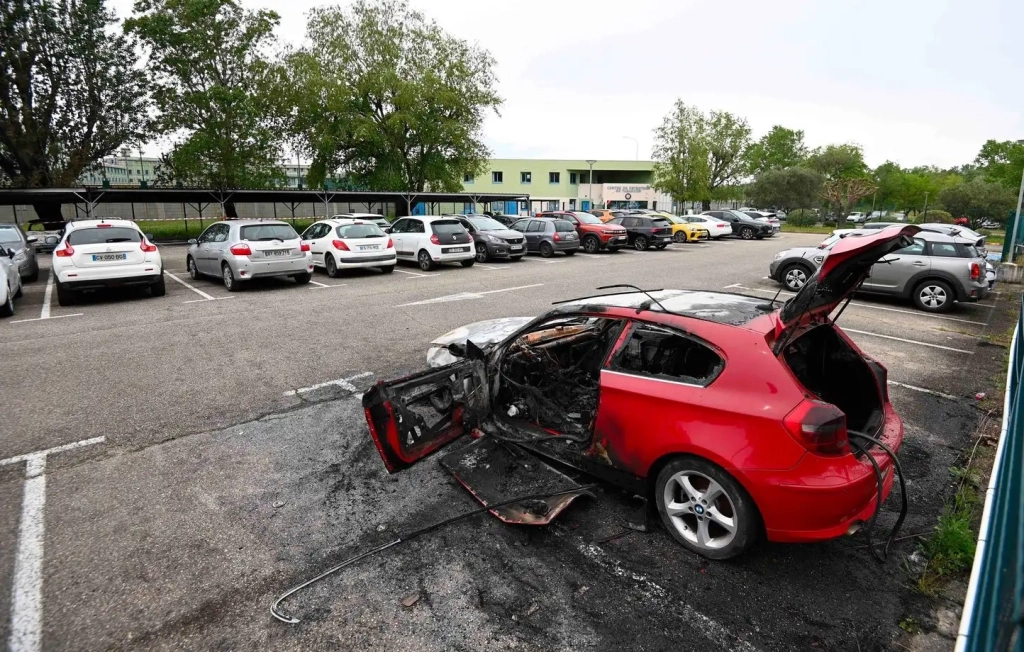
In recent days, a wave of targeted attacks in France has struck prisons, the homes, and vehicles of prison staff. The use of military-grade weapons, arson, and acts of vandalism have raised serious concerns among authorities. The investigation, now led by the French National Anti-Terrorism Prosecutor’s Office (PNAT), is exploring several hypotheses, with no single lead favored at this stage.
Olivier Christen, France’s national anti-terrorism prosecutor, emphasized the complexity of the case: “It could involve politically radicalized groups, organized crime networks, or a convergence of different profiles. At this stage, nothing is being ruled out.”

The prosecutor’s office has opened an investigation on charges of “criminal terrorist conspiracy”—a serious qualification, but one deemed appropriate given the coordinated nature of the attacks, which have occurred nationwide over an extended period.
Drug Trafficking: A Serious Lead
One of the key scenarios investigators are pursuing is a possible link to drug trafficking. The modus operandi—such as the use of Kalashnikov rifles in the attack on the Toulon prison entrance—has caught the attention of crime experts. David Dufresne, head of the Police and Justice department at LCI, cited a senior official from the Marseille police who noted that certain elements resemble tactics used by criminal organizations involved in the drug trade.
The acronym “DPF,” short for “Defense of the Rights of French Prisoners,” found at some of the attack sites, may serve as a smokescreen for a structured criminal network—potentially drug cartels or “narco-mafias.” This theory gains credibility in light of their opposition to the government’s new tough-on-crime measures, particularly those promoted by Interior Minister Gérald Darmanin.
These acts could thus be interpreted as attempts at intimidation or retaliation, as the state moves to regain control over the detention conditions of the most dangerous inmates.