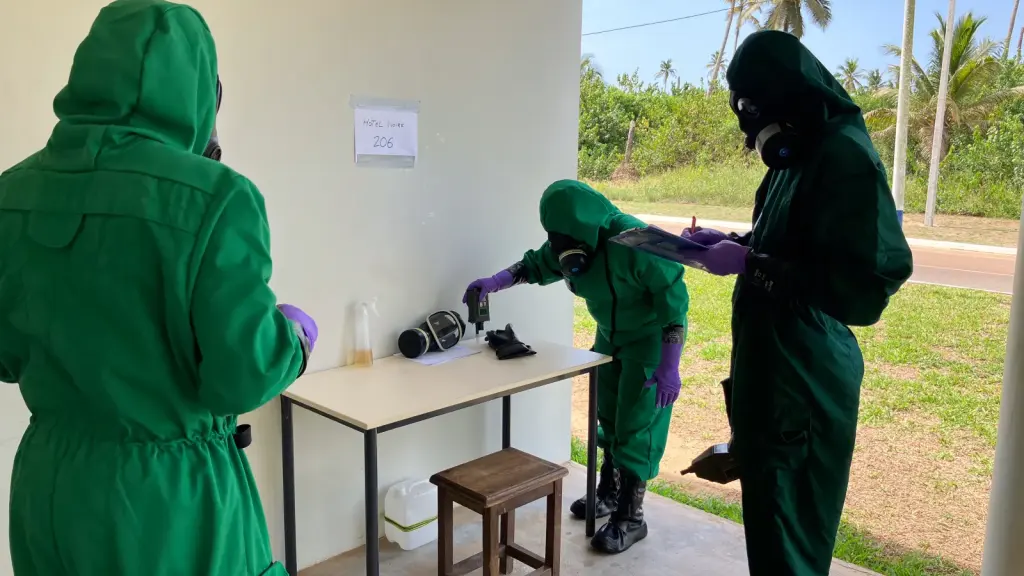
Since Tuesday, October 27, Côte d’Ivoire has been hosting 26 specialists from 14 French-speaking countries and partners in Jacqueville for advanced training on assistance and protection against chemical incidents. Organized by the Organisation for the Prohibition of Chemical Weapons, the courses and exercises will continue until November 3 at the International Academy for Counter-Terrorism.
The session combines theoretical lessons and practical exercises focused on detection, decontamination, emergency management, and victim care. It aims to enable first responders to coordinate their actions when an accident or malicious act involves a toxic substance.
The program does not focus solely on agents designed for military purposes. Loïc Luyeye, head of the OPCW present at the opening, recalled according to the Ivorian Press Agency that products used in agriculture, industry, laboratories, or mines can cause accidents or be diverted. The training therefore emphasizes a response applicable to various types of chemical risks.
The exercise is conducted with the Permanent Secretariat of the Commission for the Prohibition of Weapons of Mass Destruction in Côte d’Ivoire. France provides financial and technical support, while the Military Firefighters Group offers logistical assistance, according to AIP.
This cooperation falls under Article X of the Chemical Weapons Convention, which governs the assistance and protection of States Parties. The operational objective is to improve team preparedness, information flow, and the technical actions required before, during, and after an incident.
This is the third training session organized jointly with Côte d’Ivoire since 2024, according to AIP. In April 2025, the OPCW and the Academy had already brought together 15 participants from seven countries in Jacqueville for training on chemical incident investigation, including exercises in documentation, detection, and sampling.
The OPCW Technical Secretariat launched the call for applications for the current session on June 9. Its official schedule set the advanced course in Côte d’Ivoire from October 27 to November 3 for French-speaking African member states.
At the opening, the Director General of the Academy, Brigadier General Allah Kouamé Joseph, emphasized the ongoing training of security personnel. The participants must complete their course with integrated exercises designed to test the procedures learned during these eight days.